
Featured
Albuquerque’s Array Technologies powers ahead despite Trump’s tougher stance on renewables
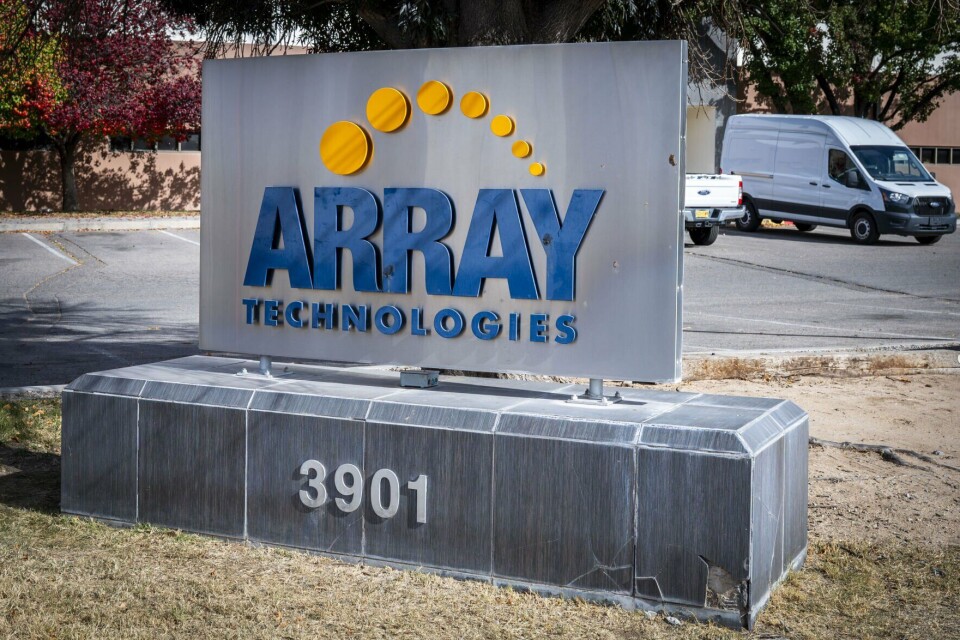
Array Technologies signage sits outside its Albuquerque headquarters on Tuesday. The solar tracking technology manufacturer reported $394 million in revenue in the third quarter.

Published
Modified
Array Technologies Inc. reported “exceptional momentum” in its third-quarter results, extending steady stock gains under President Donald Trump, whose administration’s policies have both questioned renewables and aided domestic solar producers.
The Albuquerque-based solar tracking technology manufacturer reported revenue of around $394 million in Q3, generating over $1 billion since January.
“Really, that is underpinned by the company’s really strong execution,” said Neil Manning, Array’s president and chief operating officer. “We’re really happy with the commercial momentum that we’re building with our customers.”
Array’s success — its stock is up more than 20% since January — comes as solar companies across the U.S. face financial uncertainty due to Trump’s slashing of renewable initiatives and shaking up clean energy regulations.
Signed in July, Trump’s “One Big Beautiful Bill” alters the Inflation Reduction Act, putting new restrictions on energy tax credits that slow the deployment of residential and utility-scale solar projects. This includes the absence of phasedowns on Clean Electricity Investment and Clean Electricity Production credits, according to the Solar Energy Industries Association (SEIA).
Further limiting access, the Advanced Manufacturing Production credit, a per-unit tax credit for producing clean energy components like panels, batteries and minerals, requires eligible parts to be manufactured in the same facility and final products must be made up of at least 65% domestically produced content.
While the bill’s scale back of green energy tax credits created enough unpredictability to slow down the industry, Manning noted that it didn’t “destroy demand” for utility-scale solar companies, like Array. Rather, he said, the pause in operations allowed groups to recalibrate business models to align with policy changes.
“What we’ve seen is that projects are now progressing that certainly have slowed down for a period of time,” Manning said. “We’re quite pleased with what that clarity is bringing to our customers and, as a result, we’re seeing our pipeline increase from an overall opportunity perspective.”
In a January Fox News interview, Trump criticized renewables, claiming “people don’t like massive solar fields.”
“They’re ridiculous, the whole thing,” Trump said. “And, by the way, you know where the panels come from? 100% of the panels; they’re made in China.”
This is not entirely true. According to the SEIA, domestic manufacturing has seen tremendous growth since the end of 2024, and the U.S. can now “produce every major component of the solar supply chain.”
“It’s encouraging to see domestic solar manufacturing gaining ground,” Gang He, an associate professor of energy and climate policy at Baruch College in New York, told the Journal. “But it’s equally important to keep the flow of knowledge, talent and capital open, so U.S. markets can continue to benefit from global learning, driving down costs and speeding up solar deployment.”
Array has practiced domestic manufacturing since its founding in 1989, Manning said, with a focus on a “U.S.-centric supply chain.”
Array has been able to mitigate the challenges that come with international supply, Manning added, as its U.S. operations remain “highly domestic.” In August, the company completed the first full-site deployment of its 100% domestic OmniTrack trackers for a 200-megawatt solar project in Indiana and, in 2026, will open a new manufacturing factory in Albuquerque.
With an international presence as well, Array has offices in Brazil, Spain and the United Kingdom, where it builds for those specific markets.
“That has not been a problem for us in the United States, given our heavily domestic supply chain and along with our footprint of operations that support North American business,” Manning said.
At least 65 new or expanded solar and storage facilities have come online in 2025, bringing around $4.5 billion in private investments to the U.S. However, the SEIA warns that over 100 factories with billions of dollars in the pipeline are still at risk under the Trump administration’s new guidelines.
Acknowledging that Array’s business model has proven successful, Manning said the company is always looking to grow, like improving its market share position, as well as opportunities in acquisitions or mergers. Earlier this year, Array acquired APA Solar, an Ohio-based producer of solar racks and other foundation infrastructure, which contributed nearly $17 million to its Q3 revenue, officials said.
Manning said changes and fluctuations in the industry are affectionately known as the “solar-coaster,” where maturing sectors have a certain level of volatility for a variety of reasons. But what won’t change, he added, is the structural demand for electricity.
Driven by the increasing development of artificial intelligence, data centers and U.S. manufacturing, Manning said the continued growth of energy consumption is undeniable. Solar is still the lowest-cost solution, regardless of tax incentives, he said.
“Solar is very well suited to meet that demand,” Manning said. “As a result, we have a high degree of confidence that over time, solar will continue to be a really important part of the picture when it comes to new energy additions onto the U.S. grid, and on the grid as you go around the world.”


