

Ad
Featured
Understanding Sanjay Kadu

Sanjay Kadu is the new chief design officer for Dekker Perich Sabatini.
Published
Modified
Sanjay Kadu says nex+Gen Academy, which he led the design efforts on with the firm Dekker Perich Sabatini, was the first ground-up school based upon the New Tech Foundation’s 21st Century Learning Model. In leading that project, Kadu was able to insert his design philosophy of creating an open studio environment that puts a focus on transparency and collaboration.
He speaks of the school, one of many he’s worked on over the years, as a living, breathing structure — one that offers more than just a space for students to come and learn and more than a place for teachers to clock in their eight hours.
Kadu’s new role as chief design officer, which he began at the start of the new year, is fitting for the person he is — one that is calculated in his approach to design and one that looks to collaborate on all ends.
His journey to chief design officer comes as Kadu has made his mark on architecture in the state, and as he continues to do so in his new role, in which he will oversee the design aspects of DPS’s studios that range from health care to education to multifamily housing to commercial government.
More importantly, Kadu in leading the design of the firm — one of the largest in the Southwest — will effectively make his mark on a broader swath of structural design across New Mexico, Arizona and Texas.
“There are so many things that go behind why a building looks good,” Kadu said. “There is so much (that goes into it) — it’s almost like it’s a science.”
Originally from Mumbai, India, Kadu is a third-generation architect. His father and grandfather were architects, he said.
His father had his own firm, Kadu & Associates, while his grandfather worked with the Delhi Development Authority, an Indian government undertaking.
He said his uncles and other family members are also architects, which made him gravitate toward the profession.
“I realized that, you know, he, my dad, everyone is talking about nothing but architecture in the house, so it almost felt like a default profession,” he said. “And then my grandfather would always say things like, ‘This profession is so noble because whatever we do is affecting human life. And not just immediately, but we’ll continue to do so for decades and decades to come.’
Ad
“That really resonated with me — that the profession gives us that power and the ability and the responsibility … to affect people’s lives.”
In Mumbai, Kadu received his government diploma — the equivalent to a bachelor’s degree — in architecture from Rachana Sansad. He then went to work for his father’s firm, he said.
Kadu said architecture in India is much different than in the United States. In India, he said, the mode of construction heavily focused on reinforced concrete and brick walls. They also used the metric system.
“It was a completely whole other way of designing buildings and constructing them,” he said.
But his move to New Mexico and his eventual studying at the University of New Mexico, where he earned his master’s degree in architecture, came by way of his devotion to his love for design.
He first met the CEO of DPS, Benjamin Gardner, when they were in school at the University of New Mexico. Both were also interns for DPS in the early 2000s.

“I saw his talent and his capability to really take an idea and fully develop that (idea), and be able to explain why he made every decision and move in that design or that problem, to address the problem to create the facility or the design,” Gardner said. “He’s gotten much better at that over time as well.”
In the United States, where Kadu has spent his time raising his children and working at DPS, he said the design of buildings is much different than in India, where he first learned the craft. Here, he said, the focus is on steel-frame construction.
But the transition for Kadu from architecture in India to the U.S. was relatively smooth. It usually is for those destined to reach the peak of their craft.
It also helps, too, that one of Kadu’s greatest inspirations in design is Frank Lloyd Wright, the American architect who worked on 1,000 architectural designs over the course of his career.
“I like his work because of the simplicity and the way his designs reflect the juxtaposition of the shape and the proportions and the geometry,” Kadu said. “It’s something that I really admire.”
Like Wright, Kadu speaks of the importance of making the place in which one lives more beautiful — and one full of meaning. That ethos has pushed Kadu to design schools in the region — he has primarily been with the education studio at DPS, leading it for the past 10 years — with a sense of meaning.
He said, for instance, nex+Gen Academy in Albuquerque, is a school where he really got to work closely with the staff on what their ideas were for an ideal place to learn and a place where students feel connected to everyone around them. The school features a big space for gathering and the principal’s office is encased in a glass box to make the environment inviting for students.
On the Navajo Nation in Arizona, Kadu helped design the Lukachukai Community School. He said that school called for much different needs than a school, say, in Albuquerque.
“The culture has to influence the design of the schools, where the buildings are going, we have to make sure that they are contextual,” he said. “And when I say contextual it is all about really understanding the sun angles, the weather patterns, the wind angles so that whenever we are creating any outdoor space, we need to make sure that the building blocks the wind — it has to be comfortable. … It’s a holistic process.”
He added: “They get their food deliveries like once a week — APS they might be getting twice a day — so if the power goes down, all the food goes to waste. You have to have the specific requirements of bigger refrigerators, bigger generators.”
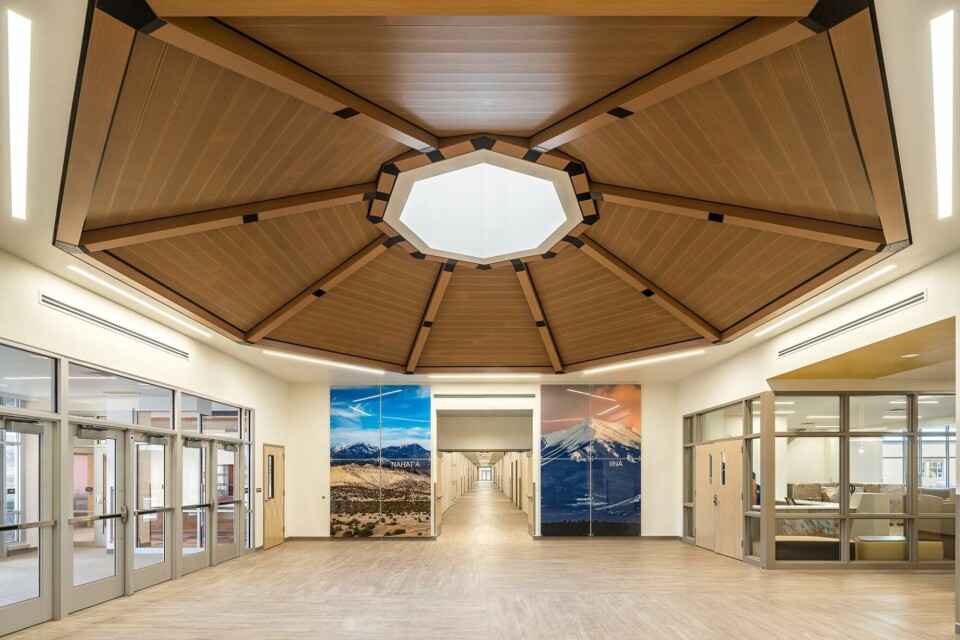
Kadu also understands that design is changing, primarily toward a place where technology is more intertwined than ever before. That is a challenge he is willing to take on, he said, and one he has to accept because, well, it’s what the future calls for.
“I see a big push towards sustainability, rightfully so,” he said. “People are talking about it and they can definitely see the effects of global warming — and architecture can definitely help because at least eight to 10 hours of our (day) we are either in our homes or in buildings.”
Benjamin also sees Kadu as the perfect fit for the future.
“He thinks things through really completely,” Gardner said. “He’s not a native English speaker, so everything he gets he has to translate in his mind. That makes him kind of think about it twice or three times and, for me, it’s always been interesting … to see him go through that process. When you speak with him, (you know) that he’s paying very close attention and analyzing that into how it translates into the process of design.”


