
GO NEW MEXICO
The sounds of a Southwest spring
From birds to frogs, a change in seasons brings music to the outdoors
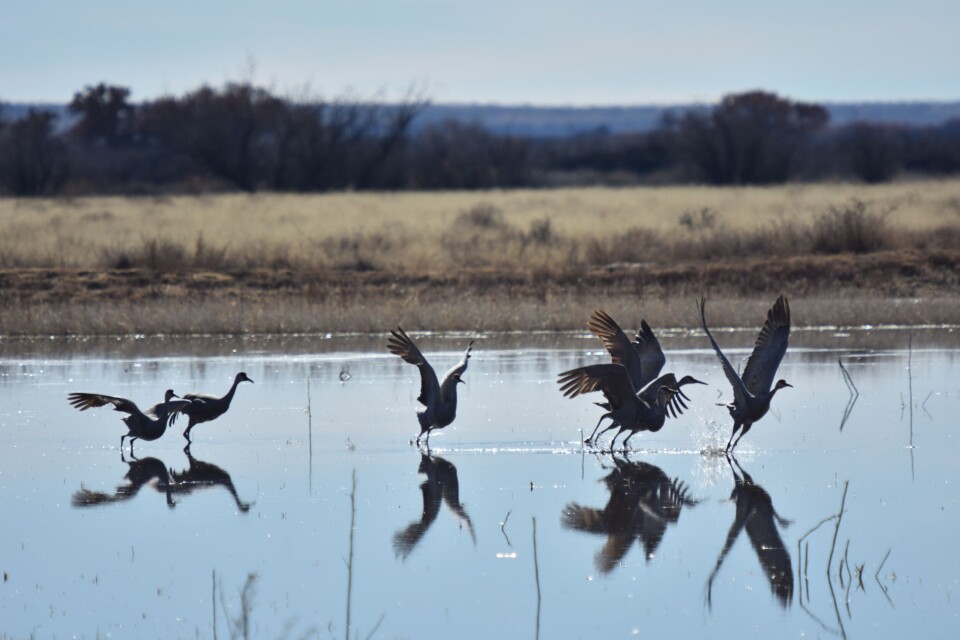


In the spring, one will hear migrating sandhill cranes above the Rio Grande before they can be seen against the hazy sky. Watch long enough, however, and you will see the flocks swirling higher and higher on the thermals of warm air over Albuquerque; the 4-foot-tall gray birds often are so far away they appear to be the size of mosquitos.
Their trumpeting and scolding are a sign that another balmy New Mexico winter is over, and it’s time for the ancient birds to head north for nesting.
Of course, there are other sounds of spring throughout our landscape. Listen closely.
Sky music
In 1851, Col. George Archibald McCall observed cranes from Santa Fe to El Paso. Florence Merriam Bailey, author of “Birds of New Mexico,” published in 1926, quoted McCall saying that especially from Albuquerque to Socorro, “for 50 miles the ground appeared to be covered with them.”
Unregulated hunting of the birds in the late 1800s reduced populations significantly, Bailey wrote, however, as wildlife laws and rules were enforced, and refuges were established, the cranes returned to the land and to the sky until today they are quite common.
Lisa Balivet is intimately familiar with the guttural trilling she calls “symphonic sky music.” She and her husband, former Journal employee Ken Smith, come to New Mexico to volunteer at the Bosque del Apache National Wildlife Refuge from November through January. When the cranes start leaving, Balivet and Smith know it’s time to head home to Anchorage, Alaska.
“The cranes nest close to our home in Alaska,” Balivet said. “Actually, sometimes we hear them from inside our house, and we dash outside to look for them. Such a gift. It feels like a very old, almost genetic connection.”
Crane fossils indicate the birds evolved roughly 65 million years ago. The Bosque del Apache NWR was established in 1939, and is a popular location for birders and photographers trying to “capture” the 406 bird species that use the refuge. The refuge includes 57,331 acres and according to the refuge’s website, species diversity is high between the last weeks of April and the first weeks of May. There are trails for hiking and biking, and a 12-mile auto tour loop.
The state’s Ladd S. Gordon Waterfowl Complex is also used by sandhill cranes and thousands of snow geese during the winter months. Anyone who wants to see the migrants without making the drive to Bosque del Apache or Ladd S. Gordon should visit the “Critters of New Mexico” or “Birding in New Mexico” groups on the web. Talented photographers post their work on these sites, and these are excellent places to learn how to identify the warblers, sparrows and other species found in the state.
National forests
Did Benjamin Franklin really believe the wild turkey should be the national bird? Wasn’t he joking?
Regardless, spring is when New Mexico’s forests are filled with the thundering blasts of turkey gobblers announcing it’s time for nesting. From the Lincoln and Gila national forests of southern New Mexico to the Carson National Forest in the north, those who wish to hear this sound of the season should venture out before dawn to climb a forest ridge and listen to the birds’ calling.
The birds roost overnight in ponderosa pines or cottonwood trees, and the widespread branches provide adequate space for landing and resting. A good place to start looking and listening is at the snowline, if you can find one, where fresh grasses and other greens are emerging. Turkeys also need water daily, so check out streams and springs in grassy areas.
Forest Service maps often label streams as “Turkey Creek” or “Gobbler Canyon.” Turkey hunting is very popular in all of New Mexico’s national forests. Calling the birds to within bow or shotgun range is the challenge, especially when the gobblers are still concentrated with flocks of hens. As the hens break away to nest, the gobblers become more willing to answer calls.
The spring turkey season starts April 15 in turkey habitats across the state. A license is required and an additional special permit issued through a drawing is required in some hunting units. Turkey hunting rules and areas are covered on pages 119-121 of the 2026-2027 New Mexico Hunting Rules and Information booklet or online at wildlife.dgf.nm.gov.
Frogs of a lifetime
National Geographic has inspired outdoor exploration since 1888. In addition to a wonderful magazine, it produced “100 Hikes of a Lifetime, the World’s Ultimate Scenic Trails.” One of those 100 hikes is Havasu Canyon in Arizona.
Havasu Canyon is located within a Native American reservation adjacent to the Grand Canyon National Park. Perhaps you read about the blue-green waters of Havasu in “Desert Solitaire,” a classic work by Edward Abbey. Abbey was a University of New Mexico student when he explored Havasu and met Havasupai tribal members. I learned about Havasu when I took a Southwest Literature class at UNM, thank you Enid Howarth, and had to read Abbey’s book.
For decades I dreamed of going hiking in Havasu. Periodically, newspapers and magazines published photos of those blue-green waters, keeping my dream alive. I finally got my chance when my grandson’s scout troop went there for spring break several years ago.
The campground is 11 miles from where the troop had to park the vehicles. A tribal brochure says it takes five hours to hike down to the campground and six hours to hike out. You must take a minimum of at least a gallon of water per person. Tribal members will haul camping gear into and out of the canyon for a fee, and scout leaders knew all about it. Those packers were not available when Abbey made the journey, but he did rent a horse from a tribal member.
Spring break in the canyon means lots of college students packing yoga mats, which were not in Abbey’s description, either. Nor did the author mention helicopters flying in and out of the canyon in the 1950s, but that was only a distraction up near the Supai Village. In all, the reservation is 167,000 acres, somewhat larger than when it was established in 1880.
I was able to join the scouts on a hike down to Beaver Falls which is really close to the national park boundary. That hike took us down a ladder-and-chain section of trail at Mooney Falls, which was beautiful but also slippery from the fall’s ceaseless mist.
Abbey caught rainbow trout in the canyon, and decades later I never saw an angler. However, I did answer a question that started upriver on the Hermit Trail into and out of Grand Canyon. Spending a May night there in a campground, I kept hearing what sounded like sheep bleating. I could not believe the National Park Service allowed sheep herding in the park, so surely there had to be some other explanation.
Eventually, I heard the same spring bleating near the scouts’ campsite, and then I saw a cluster of canyon tree frogs inflating their vocal sacs in Havasu Creek. The frogs were in a pile of sticks adjacent to a boardwalk crossing the creek, and it made a handy place to lie down and photograph the amorous frogs.
Hikers and frog listeners must have reservations to visit Havasu, and the tribe abandoned a lottery system for camping distributions. Now permits are first-come, first-served. For 2026, there was an early registration period Jan. 21-31, and an extra fee was charged. The general sale date was Feb. 1. Due to high demand, it may be too late to get reservations for 2026. Try again next year, but monitor the website regularly.
Peak season is March to October. Visit theofficialhavasupaitribe.com to make reservations. The fee is $455 per person, and pack mules are $400 round-trip. From May to September, temperatures may be higher than 100 degrees. July to September is the monsoon season, and hikers should pay attention to the signs indicating “higher ground.”


