
Featured
Three takeaways from the Los Alamos National Laboratory 'State of Lab'
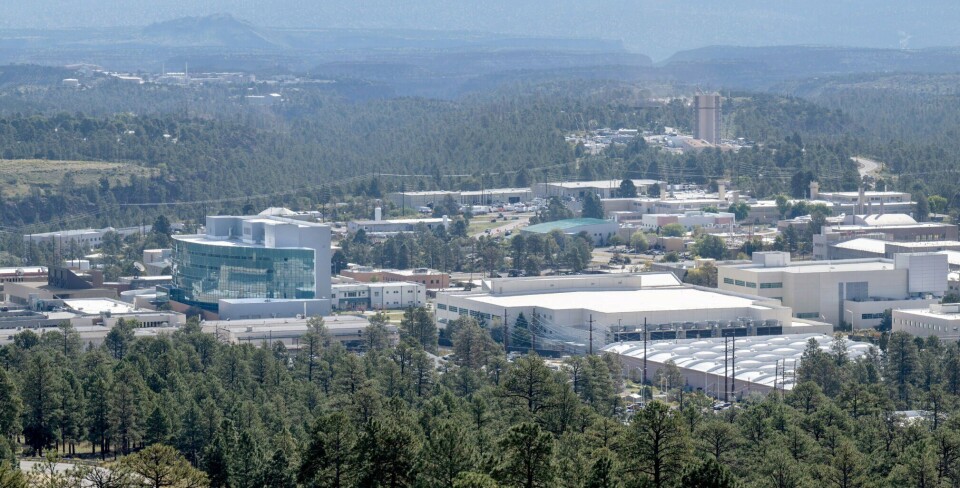
Los Alamos National Laboratory in September. Lab Director Thom Mason delivered his annual state of the lab update Wednesday.

Published
Modified
Los Alamos National Laboratory will be getting new supercomputers, making more plutonium pits and will play a role in pushing forward artificial intelligence development, the lab director shared during his annual state of the lab town hall Wednesday.
Los Alamos National Laboratory is one of 17 national labs under the Department of Energy and played a historic role in nuclear weapons development. Thom Mason has served as lab director since 2018.
Even under a new presidential administration with new leadership taking the reins at the National Nuclear Security Administration — the federal agency that oversees Los Alamos — Mason said support for the lab’s work remains bipartisan.
“I think the reason for that consistent support is the volatile geopolitical environment that we find ourselves in,” Mason said. “Unfortunately, the world is a kind of dangerous place at the moment, and whether it’s in the Middle East or the South China Sea or in Europe with a conflict with Russia and Ukraine, national security is very front of mind for our leaders in Washington.”
During the recent government shutdown, laboratory staff were able to remain at work, Mason said, because of previous appropriations. Although in an unusual move, some NNSA staff who work at Los Alamos were furloughed.
The tax package that passed in the summer, which President Donald Trump dubbed the big beautiful bill and which garnered Democrat pushback because of significant cuts to Medicaid and food assistance, included some initial appropriations for Los Alamos. Mason expects annual budget details to be clearer in January.
1. The future of AI and LANL’s role in it
Trump signed an executive order in late November launching the Genesis Mission. The order identifies the Energy Department as a lead agency in U.S. efforts to further artificial intelligence.
“The National Nuclear Security Administration plays an important component, because it’s in our mission area that that linkage between artificial intelligence and national security becomes real,” Mason said.
In general, Mason believes the U.S. and Los Alamos are ahead in artificial intelligence development.
“The one exception is probably China, which has also been leaning in pretty hard on this front, also making investments at scale,” Mason said. “The scale that we’re talking about is sufficiently large that for the most part, it’s the U.S. and China that are making a lot of the big breakthroughs.”
In August, the lab finished an environmental review process for an electrical capacity upgrade project. The project to build a new 14-mile electric transmission line has opposition from some community leaders and environmental advocates who have said it could negatively affect wildlife and cultural resources in the Caja del Rio. According to Mason, the upgrades are key for enabling future artificial intelligence and high-performance computing needs.
“Some of the very first computers were made in our electronics shops. I mean, we made them, and then when companies started making them, we would buy the first one. … And now computing is a massive, transformational industry,” Mason said. “The U.S. government, the labs, are a very small part of it, but at the beginning, we drove it, and I think artificial intelligence has that same potential.”
2. Increasing operations for plutonium pit production
Los Alamos produced its first new plutonium pit in 2024. Plutonium pits are spheres of plutonium used to arm nuclear warheads. The lab is supposed to eventually produce 30 pits annually.
“We no longer talk about the exact number of pits that we make, because we’re now making what are called war reserve pits,” Mason said. “They meet all the requirements for the deterrent. Since the number of weapons is classified, we can no longer tell you how many pits we made.”
But the lab is “meeting its production goals,” he said.
Los Alamos has increased operations to upgrade infrastructure needed for that plutonium pit production, moving to operating 24/7 in the spring.
“We need the extra time just because of the large volume of work we have: upgrading the infrastructure, improving the facility to make sure it’s fit for purpose, for the long haul … and also continuing production,” Mason said.
3. New supercomputers coming
Los Alamos is home to several supercomputers. This year, the lab’s two-year-old supercomputer Venado was moved to a classified area and ChatGPT advanced reasoning models from OpenAI were deployed on it for use on national security missions, Mason said.
“It turns out that machine was very well suited to that sort of work, because it has some of those prized Nvidia GPUs that are used for doing the training and inference for artificial intelligence, in addition to really wonderful capabilities for modeling and simulation,” Mason said.
The lab will be getting two new supercomputers in late 2026 or early 2027. In October, Hewlett Packard Enterprise was awarded the contract for the new machines. The new supercomputers will also use Nvidia chips.
Venado will be replaced by a larger machine called Vision that will be used for nuclear deterrence work connected to computer modeling, simulation and artificial intelligence.


