

Ad
Featured
'Time will tell that tale:' Man continues Hill legacy of preserving SW New Mexico ghost town


Published
Modified
SHAKESPEARE — On a windy, fall afternoon inside Shakespeare Cemetery, crows cawed as they flew over the grave of William “Russian Bill” Tettenborn and Sandy King. The headstone reads: “Hanged at Shakespeare by Vigilante Committee. Jan. 1, 1881.”
About a mile from the cemetery is the southwest New Mexico ghost town of Shakespeare where their spirits linger.
Walk down what was once Avon Avenue and there are rock foundations where saloons, homes and other structures once stood. Surrounding the foundations are a handful of buildings that remain, including the Grant House, a former stage station and dining room. Nooses hang from rafters.
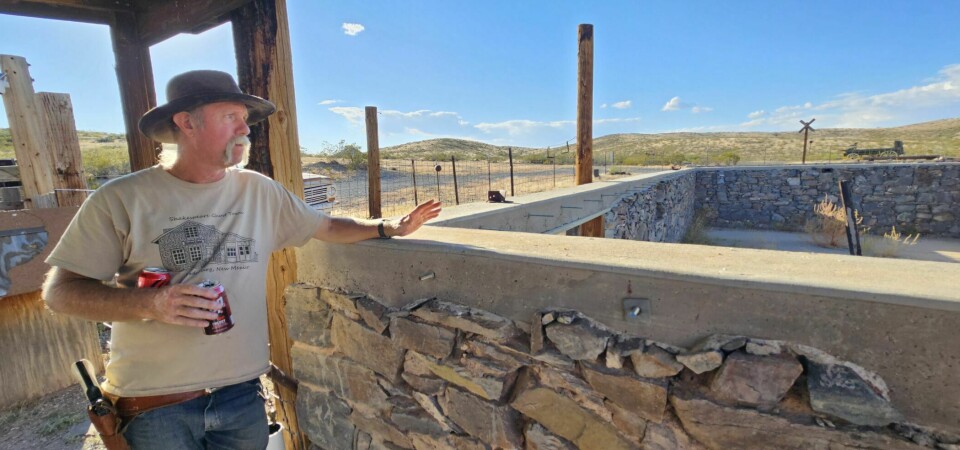
Shakespeare tour guide Dave Ochsenbine said “Russian Bill” and King were hanged there and their bodies were left for hours so an example could be made of them.
Shakespeare, outside Lordsburg in Hidalgo County, is the ideal place to take loved ones for a spooky look back in Old West and New Mexico history. Explore abandoned buildings and gravesites and picture a time when outlaws and miners were rowdy as they stopped by the desolate New Mexico community in search of a new adventure.
At different times, the town was known as Mexican Springs, Grant and Ralston City. It was a watering hole for Native Americans and others, a stage stop along the Butterfield Overland Trail and a place for people wanting to strike it rich in the mines. Or, in the case of “Russian Bill” and King, a place to die.
“History is important,” Ochsenbine said. “Folks need to learn the good and bad.”
Kind of a caretaker
Atop a hill just south of the Grant House is a small, gated cemetery where Emmanuel (or Manny) Hough, Janaloo Hill Hough, Rita Hill and Frank Hill are buried.
“If it wasn’t for those guys, Shakespeare wouldn’t be here today,” said Ochsenbine, Manny’s son-in-law.
Ad
In 1935, Frank and Rita bought the town and nearby land for ranching. The more Rita learned about the place, the more she became interested in preserving it.
“Too many old things disappear,” Rita Hill told The Albuquerque Tribune in November 1978. “Shakespeare was a very important town. It contributed much to the settlement of this part of the West.”
Frank and Rita’s daughter Janaloo and her husband, Manny Hough, later took over the town, and now Ochsenbine, 56, is doing his best to keep Shakespeare alive for future generations.
He not only gives tours but also maintains buildings like the Grant House and Stratford Hotel, which is where Billy the Kid reportedly washed dishes after breaking out of jail in Silver City.
“I will do whatever I can to help keep these buildings standing and restored as much as I can,” Ochsenbine said.
Ochsenbine moved from Ohio to Shakespeare in 2018 because he said he was fascinated with the people who once visited the town and to continue the work his in-laws started.
Ochsenbine said he is kind of like a caretaker to the town that once boasted a population of 3,000 people and had over 150 structures.
“I’m nobody special, just a guy just trying to do my part in keeping history alive,” he said.
Part of that history dates back to the 19th century.
‘It did help keep people in the town’
Shakespeare went from having a few thousand people to a couple hundred in less than a century due to the booms and busts it experienced.
In about 1856, the U.S. Army erected a building to serve as a relay station on the Army mail line between Fort Thorn and Fort Buchanan before later becoming a home, Ochsenbine said. Today, people can walk inside the adobe building and look at reproduction pieces from the 1850s.
A few years after the Army came, a stagecoach station (part of the Grant House) was added as part of a route along the Butterfield Overland Trail. The station would briefly shut down during the War Between the States.
During the War Between the States, troops came through the area, including Confederates hoping to expand the Confederacy into California. Some visitors in the stage station would later say they heard a soldier screaming as if they were being tortured, Ochsenbine said.
When the station reopened after the war, silver was discovered, prompting Bank of California President William Ralston to invest in the area. The town reached 3,000 people as miners came to get a piece of the action. The silver mined out quickly, but then a rumor began circulating that diamonds were hidden in a cigar box planted in ant beds on Lee’s Peak west of town.
“It did help keep people in the town at that time,” Ochsenbine said.
In 1872, when it was discovered the diamonds were a hoax, people left. By the spring of 1874, mining claims were changing hands again with frequency, Rita Hill and Janaloo Hill wrote in the 1967 New Mexico Historical Review article, “Alias Shakespeare, the Town Nobody Knew.”
Ochsenbine said “things got really lean” until 1879, when English engineer Colonel William Boyle came and renamed the town Shakespeare.
“The main reason for the impressive name, Shakespeare, was to obliterate all memories of Ralston and its swindles and sell stock in the new gold and silver mining company,” Rita and Janaloo Hill said.
In the Dec. 8, 1879, issue of the St. Louis Globe-Democrat, a correspondent wrote that “three or four of the mines that are being worked are true fissure veins of enormous dimensions, greater than the Comstock lode, and as rich, and in many respects resembling it.” They added that “the greatest developments of mineral ore are here at the town of Shakespeare.”
While mining was plentiful, there were no schools and churches in town.
Instead, the town had 16 saloons and the only law enforcement were vigilantes, Ochsenbine said.
The only saloon left is the one connected to the Grant House where “Russian Bill” and Sandy King were hung.
“Russian Bill’s case was simple,” former Shakespeare resident Emma Marble Muir wrote in the New Mexico Magazine article, “Shakespeare Becomes a Ghost Town.” “He had stolen a horse, not because he needed the horse, but because he wanted to show how tough he was. But a horse was a horse.”
Muir said King was a “real bad man” who belonged to a gang of cattle rustlers and desperadoes. To celebrate his arrival at Shakespeare, he decided to buy a silk handkerchief. When a store clerk asked for payment, King shot off the tip of the clerk’s little finger.
“The jury could see no homicidal intent in this, for Sandy could have shot him through the heart more easily; but could not consider it an accident,” Muir said. “So after deep thought, the jury convicted him of being ‘a damned nuisance’... In that day and place, it was just as great a crime to be ‘a damned nuisance’ as a horse thief.”
‘Just keep doing what I’m doing’
The second mining boom continued before slowing down when the Southern Pacific Railroad built its line through Lordsburg in the 1880s, bypassing Shakespeare. Then, in 1893, a depression caused the mines to close.
People moved away, taking the wood and other usable parts of their houses, allowing the adobe walls to crumble. A few of the buildings were left standing and were later rented to miners who came to work in newer mines.
Janaloo and Rita Hill said the mining claims on which the buildings stood were patented and sold in 1935 by Bob Reynolds of Lordsburg to Frank and Rita Hill.
According to a Shakespeare Ghost Town Facebook post, Frank and Rita dreamt the town would become a tourist destination. Janaloo helped them with their dream by sacrificing a career as an actress, model and world-class dancer to come home to the ranch and help preserve the town.
“I felt the theater world would probably stagger along without me, but Shakespeare Ghost Town needed me,” she said.
Shakespeare was declared a National Historic Site in the 1970s.
Frank Hill died in 1970. Rita died in 1985, leaving Janaloo and her husband, Manny, in charge of keeping the ghost town alive. They invested their own resources and rebuilt some of the buildings that were destroyed in a 1997 fire.
Janaloo died in 2005. Her ashes are buried atop the hill where her family’s gravesite is. Manny passed away in 2018, the same year Ochsenbine moved to town.
Since then, some of the things Ochsenbine has done include work on the Stratford Hotel’s dining room, getting the assay building restored and fixing the exterior of the dance studio Janaloo opened after moving back.
“Everything is a challenge when you’re trying to figure out what you’re doing next,” he said.
Ochsenbine said he plans to “just keep doing what I’m doing.” But eventually, he would like his children and grandchildren to take over.
“Time will tell that tale, though,” Ochsenbine said, “like it does all tales.”


