
Featured
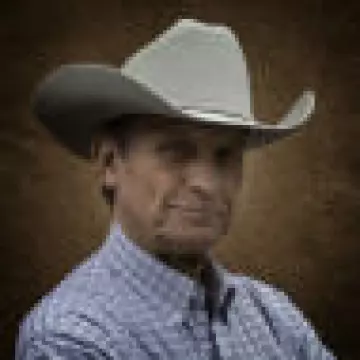
History, technology, art: Tintype photographer travels country and back in time


Published
Modified
SANTA FE — “Plate is ready, the camera is in focus, very quickly and done.”
R J Gibson photographed Simon and Maria Silva of Los Angeles near the New Mexico History Museum on a clear but chilly, windy and dusty afternoon a few days back.
He didn’t use his phone. He didn’t use a digital camera or even one of those film cameras in vogue for much of the 20th century.
Gibson makes photographs with a 1903 Graflex camera and a wet-plate process that dates back to the 1850s.
“It’s a cumbersome process,” said Gibson. “A hundred things could go wrong — like wind and dust.”
But a few minutes later, he is squatting over a shallow pan containing a thin sheet of aluminum. As he pours a fixer on the sheet, the Silvas’ image emerges.
“There you are 150 years ago,” he tells the couple. “History, technology and art.”
Reaching backYou wouldn’t guess it considering his dusty, black, wide-brimmed hat and black Western boots, but Gibson, 65, is originally from Lockport, New York.
He worked as a machinist for General Motors for 22 years, but shifted gears and started researching old-time photography techniques at the George Eastman International Museum of Photography and Film in Rochester, New York.
It was his way of reaching back into the past.
“I have loved history since I was a kid,” Gibson said. “I couldn’t build a time machine. “This (tintype photography) was the next best thing.”
From about 2000 until 2020, he worked out of a studio in Gettysburg, Pennsylvania, making portraits there and taking photographs at history-flavored events and festivals.
He earned enough of a reputation to get work in the film industry, making tintype photographs to provide period flair for movies such as “Cold Mountain” (2003), “National Treasure” (2004), “Harriet” (2019) and “Gods and Generals” (2003).
“I did a portrait of Robert Duvall as Gen. Robert E. Lee for “Gods and Generals,” Gibson said.
Occasionally, he’d land a role in a film.
“I rode in the (1993) movie ‘Gettysburg,’ with Sam Elliott,” he said. “I’m an actor. I’m looking to get into Westerns.”
Things were rolling along pretty slick for Gibson until 2020.
“That year I got divorced, COVID came along, my studio closed because there was no business and my cat died,” he said.
Gibson did the only thing that made sense to him at the time. He hit the road.
Comfort and solitude“I needed to go out by myself and heal,” he said. “On the road, I find comfort and solitude.”
At first, he started out with a 1950 Harley-Davidson Panhead cycle with a 1938 Harley package truck (sidecar for cargo). That had its limitations. He used the package truck as a darkroom, but he couldn’t sleep in it.
“And my top speed was 60 mph,” he said. “That could get you killed on the highway.”
He sold the cycle and package truck and bought a spectacular-looking 1934 Dodge Humpback panel truck, which he uses for travel, lodging, darkroom and bait for customers.
“I sleep in it like a bug in a rug, and it opens up doors,” Gibson said. “People start talking to me about the Dodge, and the next thing you know I’m photographing them.”
Gibson’s many years as a machinist enables him to keep the old vehicle on the move. It has a ‘60s Chevy Camaro engine and 1966 Ford Mustang rear axle, but it’s not invincible.
“I have laid under the truck in a snowstorm in Kentucky at 11 at night in front of an Auto Zone putting bolts in a starter while a kid from the store held a flashlight, shaking in the cold,” Gibson said.
Gibson started his itinerant life by driving from Pennsylvania south.
“I ended up in Gibsland, Louisiana, near where (Depression-era bandits) Bonnie and Clyde got killed in 1934,” he said. “And then I was in Texas and stayed in San Angelo for a while. Then I was heading to Gallup along Route 66 when I thought about Santa Fe, where I had worked on “Into the West” (a 2005 miniseries).”
Tombstone calling
Gibson arrived in Santa Fe in the spring of 2022. Counting last year and his time in Santa Fe this year, he has spent 16 months in the city.
“Santa Fe is so unique — the history, the culture — why go anywhere else,” he said. “Older people here are younger than anywhere else in the world. People in their 70s are doing things. Not just sitting at home watching TV.
“The music scene is great. I’m out listening to music or dancing four or five nights a week. The challenges of being on the road, the uniqueness of what I do — it’s demanding. My social life keeps me young. I don’t have any thought of slowing down.”
Although the solitude of being on the road appealed to Gibson initially, he said his roving life has introduced him to more people than he would have met if he’d stayed put.
“I’ve made a lot of contacts and a lot of friends.”
His Dodge panel truck is comfortable enough, but Gibson said he usually stays in a house while in Santa Fe.
“And I’ve never paid a cent of rent,” he said. “I get housesitting jobs.”
As fond as he is of Santa Fe, Gibson gets moving when the weather turns cold. He plans to leave Santa Fe after the first of the year.
“I want to go to Tombstone, maybe Bisbee and Prescott.”
Sealing the deal
Nothing Instamatic about the way Gibson makes photographs.
“I coat blackened metal with collodion, which is a liquid bandage,” he said. “It dries like cellophane. The plate becomes tacky with this stuff.”
Then the plate goes into a tank of silver nitrate in the back of his truck.
“It sits in there for a couple of minutes while I get the subject and camera ready. Then I remove the plate from the tank and put it in a light-proof plate holder. I rush that to the camera and make my exposure.”
The exposure must be made while the plate is wet. In the warmer months, when the plate dries more quickly, that means only a couple of minutes. In cooler or cold weather, Gibson has four or five minutes.
After making the exposure Gibson takes the plate back to the darkroom in his truck and pours developer on it.
“It takes 20 seconds to be fully developed. Then I pour water on it to stop development and rinse all traces of the developer off the plate. Then I put a fixer on it, and within seconds it turns from a negative image to a positive photo.”
To dry the plate, Gibson puts it in a metal box with a butane-burner pocket stove.
“Then I pour a varnish on it and that seals the image,” Gibson said. “If I didn’t, it could get wiped right off. The image is just resting on the plate.”
He handed the portrait he made of the Silvas to them.
“Thank you for keeping history alive and me alive,” he told them. “It’s guaranteed as long as I live. After that, you are on your own.”
Gibson charges $100 to take portraits, and he also sells tintypes he has previously made for $100.
Look for him in Santa Fe. Or Tombstone. Maybe Prescott.


