
Featured
Wheelwright exhibit 'Always in Relation' showcases a couple's lifetime love of Indigenous art





Published
Modified
When Ruth Schultz moved to Albuquerque from Louisiana with her husband Sidney, it was with considerable trepidation.
“She said she was a reluctant transplant, and she didn’t unpack for a year,” said Henrietta Lidchi, executive director of Santa Fe’s Wheelwright Museum of the American Indian. Then she discovered Native American art.
“She never left,” said Lidchi.
The museum is showcasing “Always in Relation,” an exhibition of more than 100 works donated by the estate of Ruth and Sidney Schultz. Centering on the couple’s collection of jewelry, vessels, artwork and objects, the show runs through Oct. 21.
After moving here in the 1950s, the pair became passionate and prodigious accumulators of Indigenous North American art. They left their mark on the Southwest art community in multiple ways. Sidney was an orthopedic surgeon who performed one of the first total hip replacements in New Mexico and offered his services in exchange for artwork. Ruth was active in writing standards for the Southwestern Association for Indian Arts, the umbrella organization for the Santa Fe Indian Market. She was a donor and board member of the Wheelwright.
“They were very gregarious,” Lidchi said. “They were a very close couple. Ruth was very devoted to Native American art. I’d see them a lot at Indian Market. My understanding is that he would give people medical consultations for free. He was always willing to give advice.”
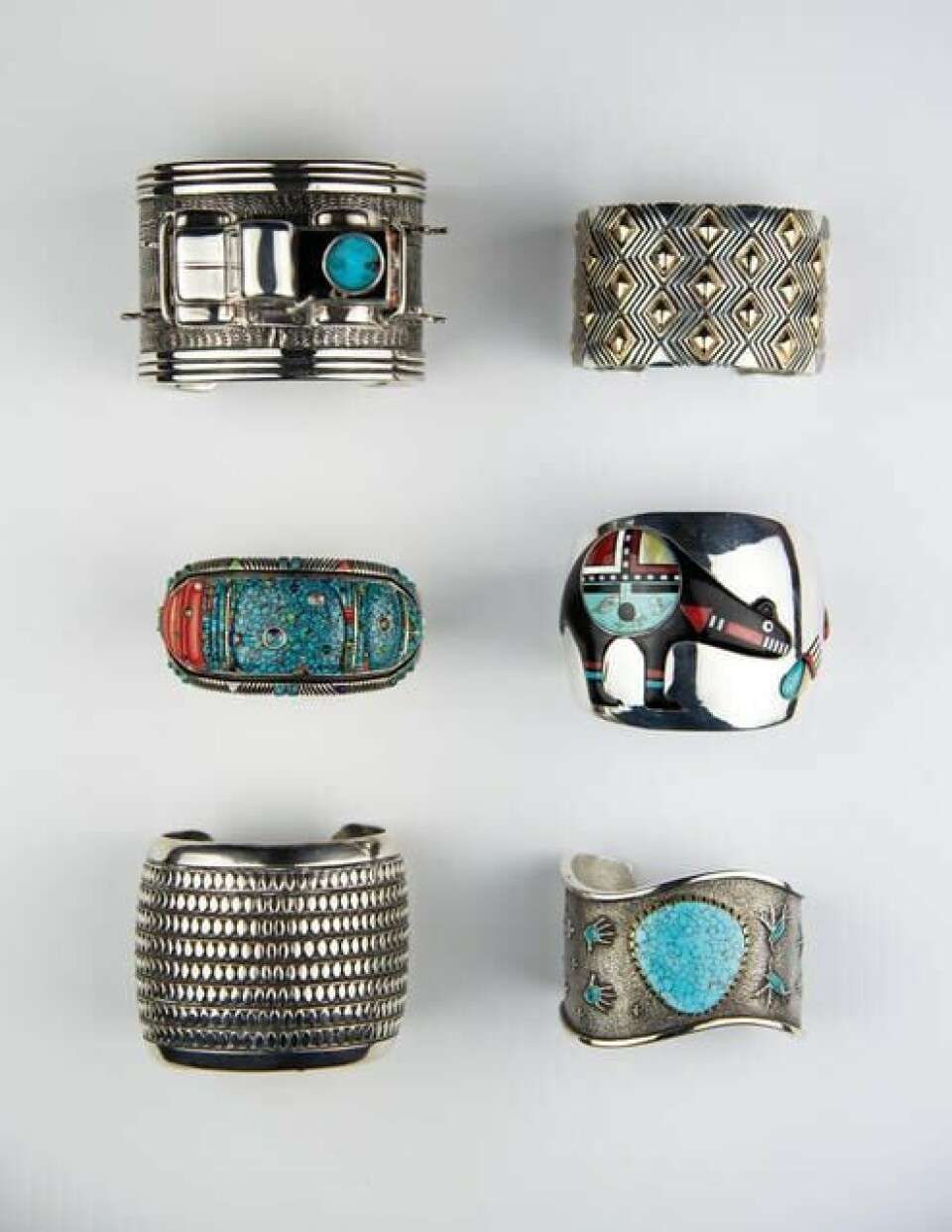
The exhibition traces the Schultz’s lives through photographs, archives and Ruth’s love of jewelry, particularly the work of Kenneth Begay. Beyond seeing themselves as “collectors,” they built strong and lasting relationships with artists across more than 70 years.
The exhibits sparkle with jewelry by glittering names such as Clarence Lee (Navajo), Gail Bird (Santo Domingo Pueblo/Laguna Pueblo), Yazzie Johnson (Navajo), Cippy Crazyhorse (Cochiti Pueblo), Preston Monongye (Mission/Mexican), Marcus Amerman (Choctaw), Teri Greeves (Kiowa), Liz Wallace (Navajo/Washo/Maidu), Denise Wallace (Chugach Sugpiaq) and more.
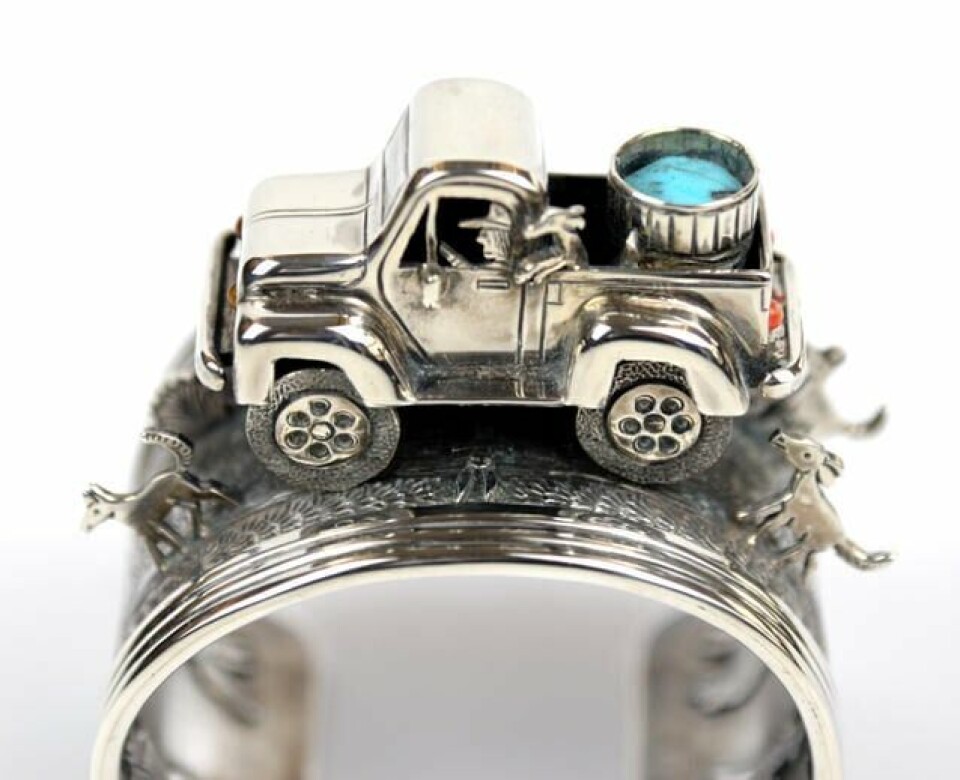
Lee’s truck bracelet balances dogs, moveable tires, a turquoise water barrel and the protruding ears of a squashed rabbit atop a cuff.
“He was a rodeo rider, so he lived near Gallup, and he would make these nostalgically affectionate bracelets,” Lidchi said. “He said it was to represent the ’50s. He was a very, very ebullient, warm person. It’s the kind of interface between jewelry and sculpture.”
Begay worked for the design house of a Flagstaff, Arizona, arts and crafts shop and attended Diné Community College. His work reveals a sleek, modernist style.
“Ruth met Kenneth in the early ’60s,” Lidchi said. “She had a very deep relationship with the family.
“They bought from emerging and established artists,” Lidchi continued. “That’s just a little sampling of what we have in the gallery. They used to buy each other gifts; he wore jewelry as well.”
The exhibition serves as a map of mutual relationships developed over time.
“It’s an act of building relationships and understanding the artwork,” Lidchi said. “As they looked at the jewelry, they remembered the people.”


