
Featured
Think tank pushes smaller classes and graduation requirement changes ahead of legislative session


Published
Modified
Every year, Think New Mexico puts forward several policy recommendations for lawmakers to consider based on “the best available research and evidence.”
But for the 30-day legislative session set to begin Tuesday, the think tank said it has more than just research to back up its recommendations.
On a $100,000 bequest from the late artist Edwina Milner, Think New Mexico in November sponsored a poll of 403 registered voters on their support for specific education policy reforms, from changes to high school graduation requirements to implementing smaller class sizes, and made legislative recommendations for lawmakers to consider based on the results.
Some 183 of the survey’s respondents were parents with children currently or previously enrolled in public schools.
Some of Think New Mexico’s recommendations reflect, or are similar to, initiatives the think tank or lawmakers pushed during last year’s session.
The think tank says the recommendations it’s putting forward also represent ways to capitalize on lawmakers’ accomplishments from last year that also represent the interests of the public, not just policymakers.
“We believe this is an ideal time to begin to build on some of the reforms that have been initiated last year,” said Fred Nathan Jr., Think New Mexico founder and executive director. “There’s still much more that can be done to improve our ranking for education quality.”
Download PDF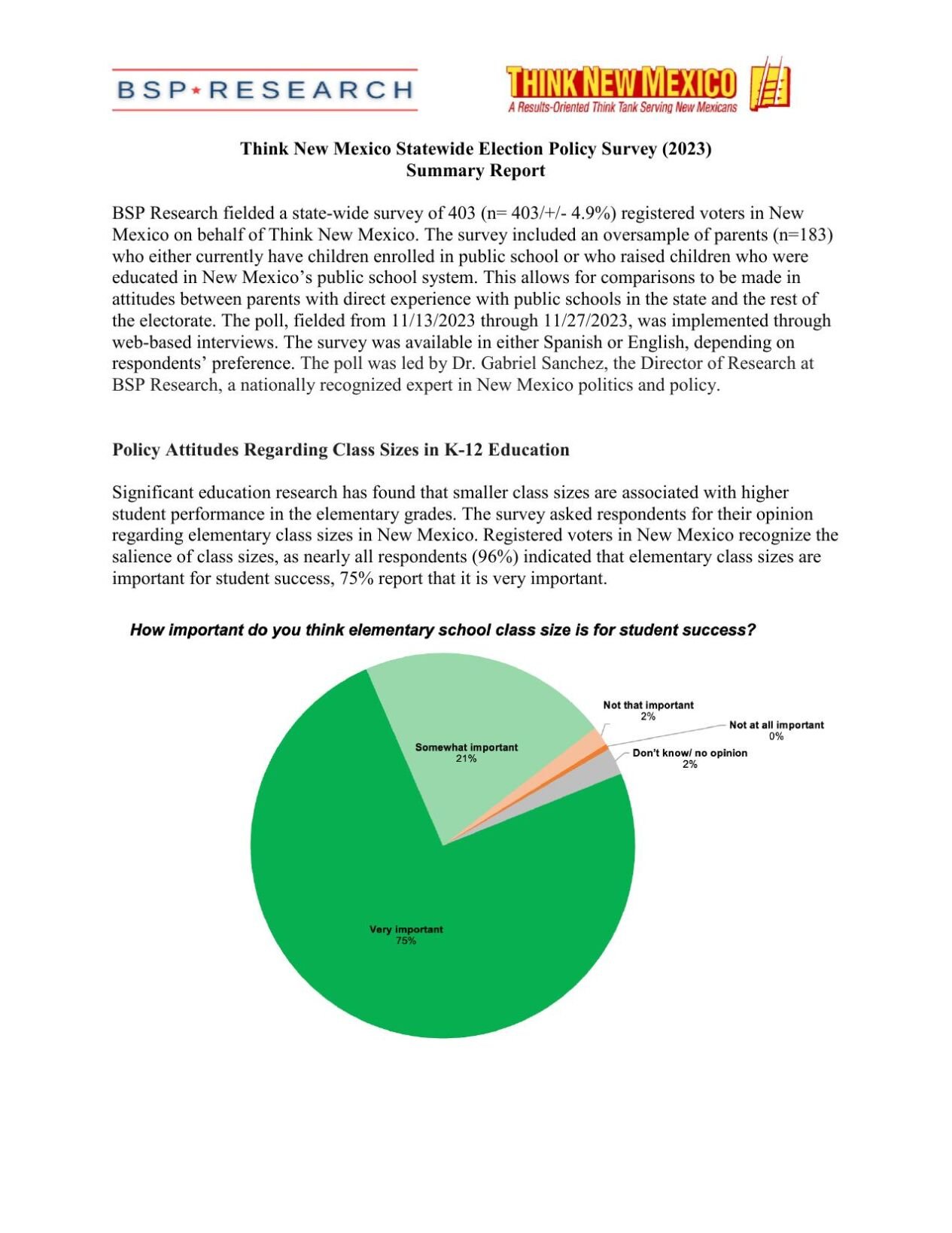
Class sizes
Reducing class sizes is commonly supported by teachers and parents alike, and Think New Mexico in turn is recommending legislation to establish caps of 20 students per class for first through sixth graders.
Some 55% of respondents to Think New Mexico’s poll believed class sizes in the state’s elementary schools are too big, and about 84% support a state law setting a 20-student maximum for each class.
Among respondents with children in public school, that number was higher, at about 86%.
Currently, kindergarten classes are capped at a maximum of 20 students, as long as their teachers have the help of an educational assistant. The average class load for teachers of first through third grades can’t be greater than 22, again assuming the help of an EA in first grade classes, and it increases to 24 for teachers of fourth through sixth grade classes.
But smaller class sizes aren’t something New Mexico public schools can accomplish with the wave of a wand.
Between the additional space for classrooms and educators a school would need to sustain smaller class sizes, New Mexico Public Education Department spokesperson Nate Williams wrote in an email, schools across the state don’t always have the resources to make classes smaller.
“Funding for additional space and more staff is always a challenge,” Williams said. “School budgets try to maximize the resources they have, and that often leads to difficult decisions regarding funding and resources.”
A snapshot report totaling up job postings from throughout the state released by New Mexico State University in October put the total educator vacancy count at the time at 1,471. Of those vacancies, 751 were teaching positions.
But teacher vacancies, Think New Mexico Education Reform Director Mandi Torrez said, are exactly why the state should think about implementing smaller class sizes, arguing that fewer students means a better workload.
“We’ve got to improve their working conditions. We’ve got to make their jobs easier,” said Torrez, a former teacher. “We keep asking them to do more and more, and we’re not taking anything away. So this is a way to give them the support that they’re asking for.”
To address the logistical issues the PED pointed out, Think New Mexico proposes the state phase in class-size caps for one new grade per year, to give schools time to gather the resources they need.
Graduation requirements

Think New Mexico is also recommending legislation updating the state’s graduation requirements for high schoolers.
That’s based on more than 80% of poll respondents saying they would support New Mexico establishing each of the following requirements, among others: a minimum of one semester of civics; at least one year of computer science or digital literacy; and at least a year of career technical education.
Those changes garnered a similar level of support among respondents from both sides of the political aisle, as well as among those with children in public schools.
“It’s really about making sure that we provide students with a well-rounded experience,” Torrez said. “We want them to leave high school with a set of foundational skills that’s going to set them up for success in whatever path that they take.”
Last legislative session, lawmakers tried to change the state’s graduation requirements through a bill that, among other things, would have cut by two the number of units high school students need to graduate.
That bill faced significant debate, some centering on whether financial literacy should be a required course. It ultimately passed in the state House and Senate but was vetoed in early April by Gov. Michelle Lujan Grisham, who contended the bill “weakens graduation standards.”
Think New Mexico’s recommendation for this session more or less addresses each of the concerns Lujan Grisham raised in her veto message, leaving in requirements about workplace readiness, physical education and dual credit, honors or advanced placement.
When asked if the PED and Governor’s Office were discussing changes to the state’s graduation requirements, Williams said the department wasn’t necessarily planning such a proposal during the upcoming session.
In its statement, the PED did say Think New Mexico’s recommendations are “all ideas that we are considering as part of our ongoing evaluation process.”
Other recommendations
Most respondents to Think New Mexico’s poll also said they would support increasing the training requirements for school board members and require that all school board candidates disclose campaign contributions.
In New Mexico, school board candidates in districts with more than 12,000 students must report campaign contributions and expenditures. But of the state’s 89 districts, the Secretary of State’s website only lists five districts as being bound by that requirement.
Two bills from the last legislative session would have updated school board governance requirements, one of which would have established mandatory training for board members. But both died in committee.
In that case, the Legislative Education Study Committee recently endorsed a bill that would nix the 12,000-student requirement for campaign finance reporting and establish 10 hours of mandatory training for new board members.
Finally, the think tank also has a recommendation aimed at revamping the state’s colleges of education that would require aspiring teachers to spend their final year of college in a teacher residency program or other type of apprenticeship.
Last school year, the PED said 226 students completed teacher residency programs, which place teachers-in-training into classrooms with experienced educators for a year. Currently, the PED said, there are 282 teacher residents across New Mexico.


