
Featured
Ted Rush of Albuquerque — musician, soldier, softball player and coach — turns 100


Published
Modified
Ted Rush was thrilled to have made his early 1940s high school basketball team in Chicago. But there was one problem.
Basketball practice, Rush recalled in an interview at his Northeast Heights home on Saturday — three days before his 100th birthday — directly conflicted with band practice. And young Ted was as gifted and skillful a clarinetist as Howie Dallmar (look him up, we’ll wait) was a basketball player.
So, music won out, eventually leading to a 35-year career in Albuquerque as a concert clarinetist, a director and conductor of the Albuquerque Symphony Orchestra and as an Albuquerque Public Schools music teacher — though not before Rush had witnessed some harrowing things on the island of Okinawa as a U.S. Marine during World War II.
Rush, over the span of his life, has never lost his love for sports, nor the value he’s attached to physical activity. That’s why, while teaching at two Albuquerque high schools, he made sure there was no time conflict for his students between music and athletics.
“My kids had band first period,” he said. “Not last period.”
That’s why, after he retired from APS at age 60, he joined a senior softball team.
“I had a neighbor up the street, who said, ‘Ted, why don’t you come and try out for a softball team?’” Rush said. “I made the team, and he didn’t. I felt so badly about it.”
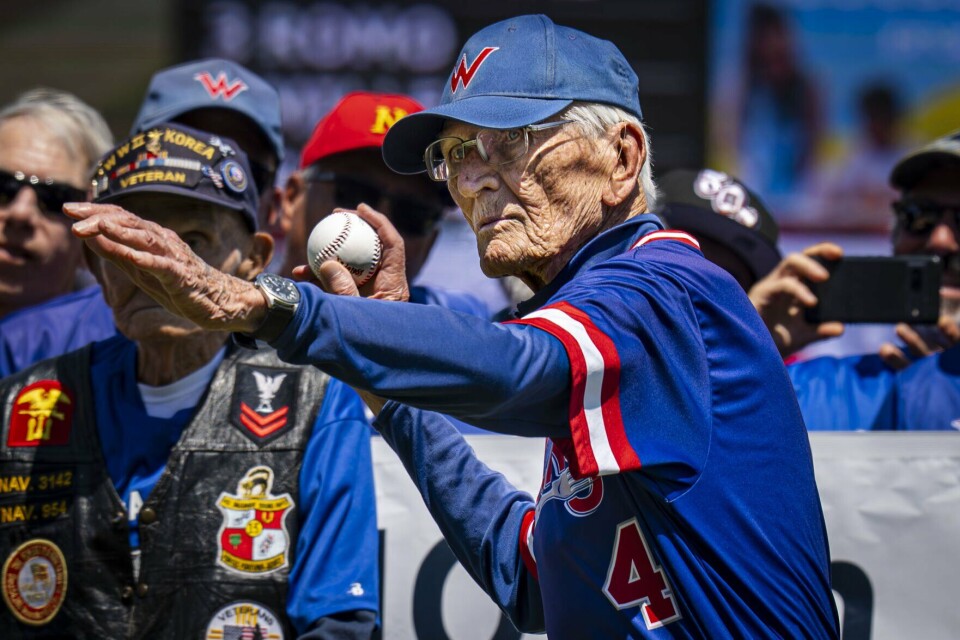
And that’s why Rush on Sunday — for the sixth time — was invited to throw out the first pitch at an Isotopes game.
He wasn’t going to be nervous, Rush had said on Saturday — not after having thrown out the first pitch five times before; not after having played clarinet solos and conducted orchestras for decades in front of large crowds; certainly not after having carried wounded soldiers to safety on Okinawa as a litter bearer with bullets flying overhead.
And, clearly, he wasn’t nervous. Standing straight and tall some 35 feet from home plate on Sunday afternoon, wearing his Weck’s softball jersey, with his teammates gathered behind him and with a “Happy 100th birthday, Ted!” banner unfurled, he hurled a strike at the knees of an imaginary batter, caught behind the plate by Isotopes player Blaine Crim.
Lawrence Talamante, like Rush a centenarian and like Rush a veteran, also threw out a ceremonial first pitch on Sunday.
At 100 years old as of Tuesday, Rush still drives a car — “carefully,” he said with a smile. He has the alertness and the recall of a far younger person. A widower since 1993, he has his son, Mark, living with him. His daughter, Celeste, who lives in England, is visiting on the occasion of her father’s birthday. Mark and Celeste, like their late mother, Bebe, are concert violinists.
What’s the secret to this centenarian’s longevity and vitality?
It’s not so much genetics, he said. His parents and siblings passed in their 70s or early 80s. More, he said, it’s a combination of diet, fitness and and social interaction.
He hasn’t drunk hard liquor since his discharge from the Marines in 1946, he said, though he’d not turn down the occasional beer. Years ago, a friend in the Albuquerque music community sold him and his wife on the value of organic food.
During his 28 years teaching music at Sandia High School, he often ran laps around the track after classes.
“One of the kids said, ‘Have you seen Mr. Rush run around the track? You should go see him, he flies around there.’’’
Today, he often takes walks around his neighborhood.
Rush is a member of the Unitarian Church.
“I had my 90th (birthday) celebration at the church,” he said. “And there were so many people, they couldn’t accommodate (everyone).”
The Weck’s softball team, as well, has been a valuable social outlet. He stopped playing at age 90 but still serves as a coach.
“Having softball twice a week, meeting real great people,” he said. “We’ve had doctors on our team, dentists, schoolteachers, professional people. Firemen, people who work for the city. We’ve gotten along real well.”
Beyond that, Rush exudes an equanimity that few can match.
Not even the horrors of war seemed to faze him.
Though he was a musician for most of his tour with the Marines, he carried wounded men, often grievously so, from the front lines to a forward aid station during the horrific battle on Okinawa.
“You’re not scared,” he said. “You have a job do to, you go out and do it.
“That’s all. You don’t think about (the danger).”
After taking Okinawa, at the cost of hundreds of thousands of lives on both sides of the conflict, allied forces were planning a land invasion of Japan. But the high cost of lives on Okinawa was a factor in the decision to drop atomic bombs on the Japanese cities of Hiroshima (Aug. 6, 1945) and Nagasaki (Aug. 9).
When the Japanese surrendered Sept. 2, 1945 on the USS Missouri in Tokyo Bay, Rush was with the Marines at nearby Yokosuka Naval Base, which the Allies had captured on Aug. 30.
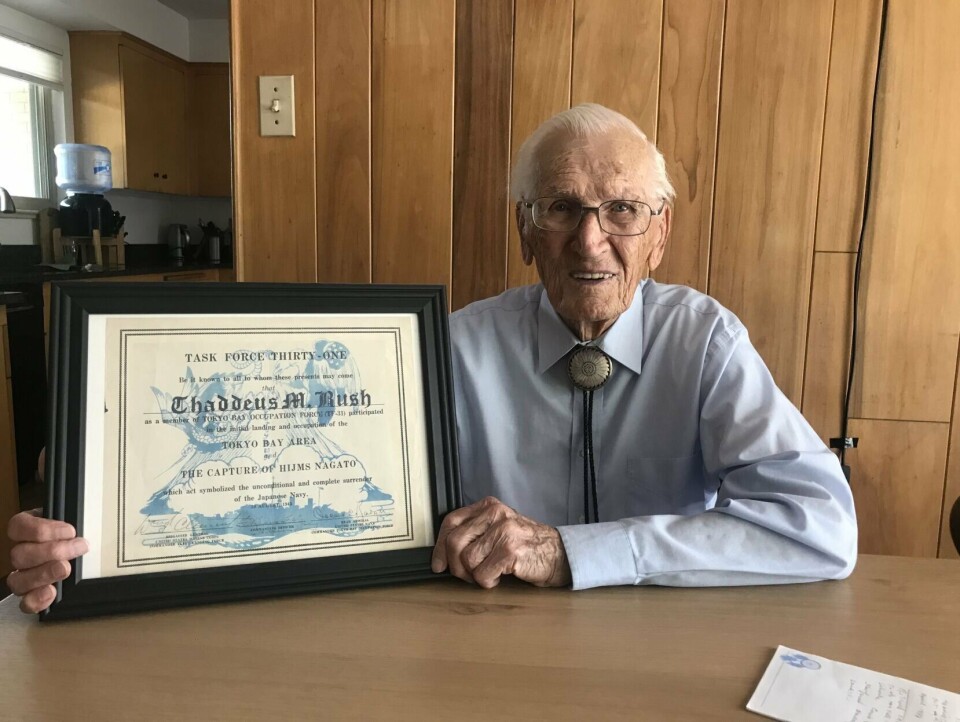
He proudly displays a plaque awarded to Thaddeus M. Rush (his given name) for his participation in the capture of the Japanese battleship Nagato.
After his discharge in 1946, Rush studied at Northwestern and at Chicago’s Roosevelt College while playing first clarinet in the Chicago Civic Orchestra.
Having earned bachelor’s and master’s degrees in music education, he set about finding work as the 1950s unfolded. The Albuquerque Public Schools, he learned were looking for music teachers. “Albuquerque?” he wondered. “Where’s that?” But he took the job.
His first assignments were to Garfield and Ernie Pyle junior high schools. Ernie Pyle Junior High was named in honor of a famous war correspondent who’d bought a home in Albuquerque shortly before World War II began.
Rush had met Pyle on Okinawa shortly before the journalist was killed by a Japanese sniper’s bullet on April 18, 1945.
“Two weeks ago they had a little get-together, a party at the Ernie Pyle Library (Pyle’s former Albuquerque home),” he said. “I went there and introduced myself … it was nice.”
Rush moved to Valley High School in 1954, then to Sandia in 1958. He retired in 1986.
As of Saturday, Celeste Rush said, 105 people had RSVP’d for her father’s 100th birthday party on Tuesday.
Coming to Albuquerque in 1951, Rush said, was one of the best decisions he’s made.
“As I keep saying, Albuquerque’s been good to me,” he said. “The people have been great.”
And clearly, his high school basketball team’s loss was Albuquerque’s gain.


