
book of the week
One with nature: 'A Pagan Polemic' a collection of aural historian and author Jack Loeffler's essays
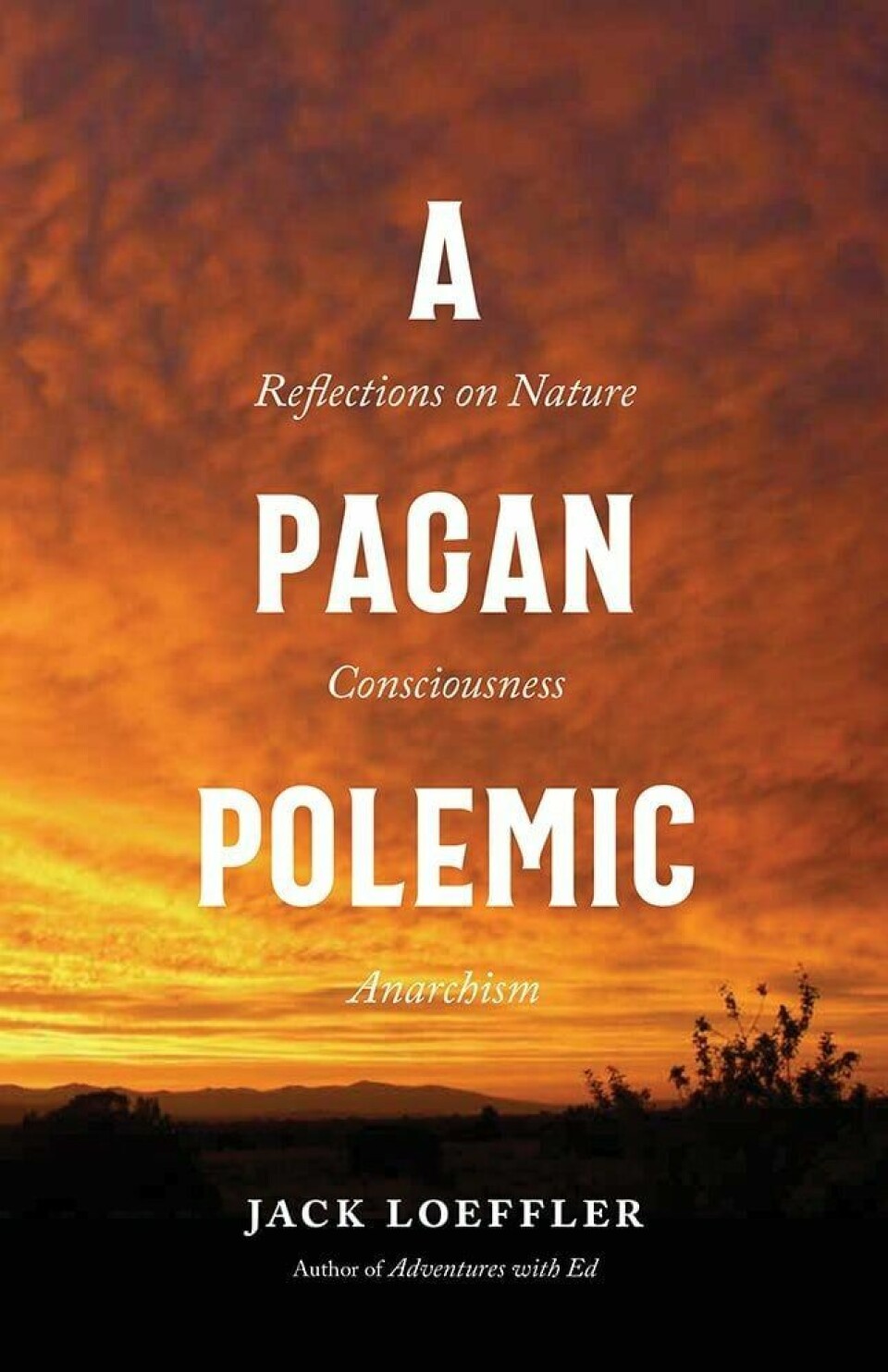
A Pagan Polemic

Jack Loeffler is 87 years old, but you wouldn’t know he’s an octogenarian by the way he passionately talks about the many lives he has lived. And still lives.
“I’m autonomous and still healthy enough to do what I do. So I read a lot and walk,” he said in a phone interview from Durango, Colorado. He recently moved there after more than half a century living in Santa Fe.
And Loeffler still writes. His new book is “A Pagan Polemic: Reflections on Nature, Consciousness, Anarchism,” which is a collection of 18 essays, three of which are published for the first time. Those three include “The Colorado River Compact is 100 Years Old.”
You could say that the book’s prologue is a personal essay. Titled “Rambling Reflections of the Reservoir of Memory,” it prepares readers for the meaty main section of essays.
The prologue indeed rambles, though coherently, as Loeffler highlights some of the major pursuits over his life — playing the trumpet in an army band, yielding to his peripatetic bent, “with or without purpose — by pickup truck, by foot, or by raft,” studying the world’s religions, his life-long aural recordings of Indigenous peoples throughout the North American Southwest, watching the night sky and being aware of other possible universes, noting that humans on planet Earth are “squandering the resources necessary for life as we know it …” and perhaps most significantly thinking of the human species as part of what he terms the bigger picture of “the flow of Nature.”
Loeffler reflects on his experiences amidst other species in this magnificent flow.
“I’ve always loved being ‘out in it,’ watching, sensing, listening, intuiting, registering Nature’s great revelations,” he writes.
Loeffler refers to himself as a “naturist,” though not the definition of the word that means a nudist. Rather, he’s one who worships Nature.
The prologue offers a bit of Loeffler sage advice on the subject: “The flow of Nature runs deep through our species, if we would but listen to its song.” Maybe plural songs, as in songs of other cultures and other species.
Loeffler links nature to what he sees as an aspect of his brand of paganism.
He doesn’t subscribe to any organized religion. But he had studied the Tao Te Ching, he found the Bhagavad Gita more interesting than a college class on the Bible, and he has friends who practice Zen Buddhism.
A self-described aural historian, Loeffler has recorded — and learned from — many traditional Indigenous peoples in the North American Southwest. North American because he’s crossed geographical boundaries to interview Indigenous peoples in the American Southwest and in northwestern Mexico. Among them are the Navajo, the Hopi, the Seri, the Tarahumara. He’s recorded them talking about their perspectives on life, the importance of nature and the sacredness of homeland.
The prologue further takes the reader into a discussion of planet Earth as humanity’s natural habitat.
That leads to Loeffler’s suggestion that human consciousness has such potential, yet it is squandering its resources. And in turn that segues to his belief, ignited by his friend, the late, environmental activist Edward Abbey, that corporate power fuels political power.
Abbey, one of Loeffler’s environmental activist-heroes, wrote “Desert Solitaire” and “The Monkey Wrench Gang.” Other heroes include the late pioneering conservationist Aldo Leopold, author of “A Sand County Almanac,” and venerable environmental activist-Beat poet Gary Snyder.
Loeffler explained in a phone interview his notion of anarchism: “It’s not an attempt to violently overthrow the government on high, but to reinvigorate self-governance and put habitat at the head of the table of any governing body. That’s critical. That’s the only way. Put habitat first, and the rest of it falls into place.”
Chapter 15 is the essay “A Case for Naturist Anarchism” originally published in Green Fire Times in February 2018.
Almost all the previously published essays in “A Pagan Polemic” appeared in Green Fire Times, a Santa Fe-based magazine in existence for 14 years. Its mission is to highlight multicultural education and community development, including offering writing mentorships, through the Southwest.
The editor-in-chief of Green Fire Times is Seth Roffman. He praised Loeffler’s life work in phone interview: “Jack Loeffler is a living treasure. He’s been so actively involved in many important environmental and cultural issues for many decades. He’s been a cultural preservationist with the Hispanic community maintaining Norteño music.”


