
Featured
Blakey: APS students made math proficiency gains, but 'challenges remain'



Published
Modified
Certain historically underserved groups of Albuquerque Public Schools middle school students made gains over the last year on a statewide math proficiency assessment, Superintendent Gabriella Blakey told school board members this week.
Students with disabilities and economically disadvantaged students scored higher on the mathematics summative assessment over the past three years, but “challenges remain” for Native American, African American and English-learner students who took it, according to Blakey.
“Proficiency in math by eighth grade is critical as it lays the groundwork for success in algebra, which is a key indicator of academic achievement in graduation rates,” she said.
Members of Blakey’s team who answered questions on Wednesday for the school board about the latest math proficiency report said the gains could be attributed to things like self-efficacy among students and strategic lesson plans. The proficiency decreases, the administrators said, could have come from poor instructional materials or a lack of resources.
Math proficiency was something Blakey flagged in her recent State of the District speech, in which she said only 26% of APS eighth graders were doing well. Students identified in the Yazzie-Martinez ruling “are even further behind,” she added during those remarks.
The ruling, issued by the late 1st Judicial District Court Judge Sarah Singleton, found that the state failed to uphold its constitution to provide all students an equitable education. Singleton also found the state failed to fund programs to help these students, so she ordered officials to make reforms.
But more than six years after Singleton’s order, the Yazzie-Martinez case remains a source of strife. That was evident in Santa Fe on Wednesday, during a legislative committing meeting in which lawmakers expressed frustration over the state’s inability to come into compliance with the ruling.
The legislative wrangling was not mentioned during the APS school board’s discussion, which lasted more than an hour.
Math proficiency is one of the four goals established by APS and the Board of Education in 2023, according to the district’s website. This particular goal focuses on getting middle school students to demonstrate grade-level proficiency or above on the state math assessment.
The goal includes increasing the percentage of math-proficient sixth graders to 22.6% by May 2026; seventh grader proficiency to 19% in May 2026; and eighth grade proficiency to 20% in May 2026.
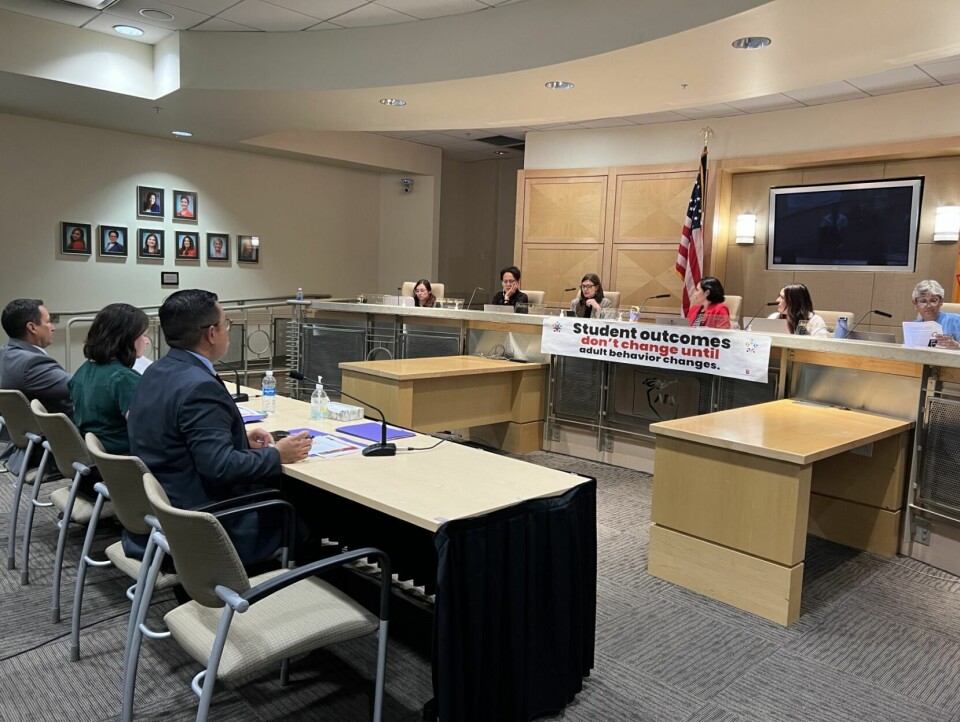
The APS school board monitors the progress of its goals monthly, with data issued in a report compiled by district staff. They answer questions from members during public meetings when goal monitoring is on the agenda. Following the discussion on Wednesday the board unanimously voted to accept the report, which shed some good news.
The scores of sixth graders who took the mathematics summative assessment increased by 5 percentage points, from 16.6% to 21.6%. Seventh grade scores increased by 4 percentage points, from 13% to 17%, and eighth grade scores increased by 1.7 percentage points, from 11.3% to 12.8%.
Board chair Danielle Gonzales asked what contributed to the 1.7% gain. Associate Superintendent Sheri Jett responded it could be attributed with “us elevating skills, habits and mindsets,” one of the board’s four goals.
Gonzales noted the trend of eighth grade Native Americans who were proficient in math had dropped from 10.7% during the 2021-22 school year to 8% in the 2023-24 school year.
“As much as I want to celebrate the progress that I’m hearing tonight, the notion that the Native American eighth grade students in math are in single digit proficiency is heartbreaking, alarming (and) tragic,” Gonzales said.
She asked district officials on Wednesday whether there was a strategy they deployed that did not work and there were lessons learned.
Deputy Superintendent Antonio Gonzales responded the materials were to blame.
“(We had) materials that were not coherent, were not aligned, and outdated,” he said. “If you’re going to build something, you need the tools to build it well.”
Antonio Gonzales also blamed lack of alignment of programming, services and support from the APS administration to district schools.
“How do we build a system of support for our practitioners to be able to, in a culturally and linguistically sensitive manner, engage with our Native American student population?” he said.
The deputy superintendent said while some students with a large Native American population might have a resource teacher or Navajo class, other schools do not.
Blakey told Danielle Gonzales that the data she is referring to reflects math proficiency up to last school year.
“So a lot of the work that the team is talking about in this strategy haven’t been able to be measured yet,” Blakey said.
Board member Josefina Dominguez, who led the math proficiency discussion, told the administrators, “You’re working so hard and (I) appreciate the work that goes into these monitoring responses.


