
Featured
Water Authority breaks ground on $8 million outfall restoration project



Published
Modified
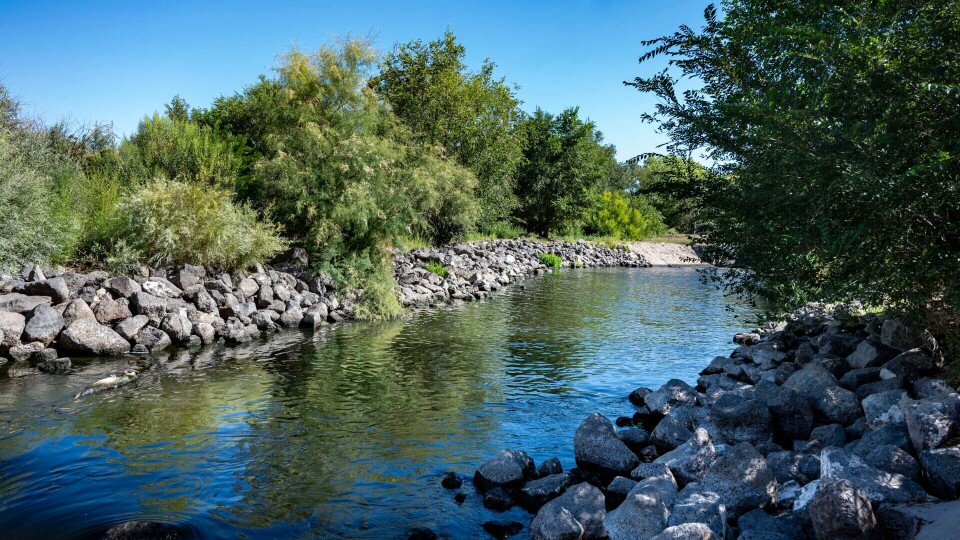
South of Rio Bravo, through a gate, across a metal bridge over a ditch full of running water and up a soft dirt route in the bosque, a stream of visitors found the fifth-largest tributary to the Rio Grande: the outfall channel from Albuquerque and Bernalillo County’s wastewater treatment plant.
It’s where the Southside Water Reclamation Plant releases 50 million gallons per day of clean water into the Rio Grande. There is a clear line where the clean effluent water meets the sediment-heavy river.
The outfall is already a popular spot with fishermen, but after an $8.6 million restoration project, the outdoor space should be more inviting to visitors with nearly a mile of new trails, and more inviting to wildlife, with a restored floodplain habitat. Construction should cost $6.7 million, while $1.9 million will be spent on planning and permitting.
Ground was broken on the restoration project Wednesday morning. Construction should begin in September and will take eight months to complete.
Guests were offered coffee and a basket of bug spray before listening to speeches from county, state and federal officials. The effluent into the Rio Grande burbled behind the speakers.
“This is the lifeblood of the state that runs north to south, that has sustained communities for so long, but also has sustained wildlife,” said U.S. Rep. Gabe Vasquez, D-N.M., who represents the 2nd Congressional District, which includes the South Valley.
The Albuquerque Bernalillo County Water Utility Authority restoration project will focus on 14½ acres of bosque, removing aged jetty jacks and invasive plant species like Russian olives and salt cedar.
The project will also change the bank around the outfall from one that drops off abruptly to a flood plain that gradually lowers. The change will make it easier for floodwaters to mix with the outfall water, improving overall water quality. The habitat should be better for endangered species like the Rio Grande silvery minnow, according to a project summary.
The restoration project is relying on state funds — $5 million from the Legislature and Water Trust Board and $566,000 from the Office of Natural Resources Trustee — and federal dollars, a $3 million WaterSMART grant from the Bureau of Reclamation.
Albuquerque is the first of 18 collaborative ecosystem projects in the western United States that Reclamation is funding with WaterSMART grants. Reclamation was given new authority under the Bipartisan Infrastructure Law to do projects beyond irrigation, municipal water supplies and drought resilience, said Bureau of Reclamation Deputy Commissioner Roque Sanchez.
“For Reclamation, the Bipartisan Infrastructure Law has provided us with $8.3 billion of funds over five years for water infrastructure projects just like this, and also ranging to projects like the eastern New Mexico regional water system, the Navajo, Gallup water system up in the Four Corners region,” Sanchez said. “From the Inflation Reduction Act, we were also provided with $4.6 billion for programs and projects that directly impact the drought that we’re facing in the Colorado River Basin, as well as other basins that are facing similar levels of drought.”
Some of the state dollars, the $566,000 from the Office of Natural Resources Trustee, were the first seed for the outfall project and came from two legal settlements that companies had to pay for damaging natural resources in the South Valley. Natural Resources Trustee Maggie Hart Stebbins commended the Water Authority staff for leveraging that funding into an $8 million project.
She also thanked Mountain View neighborhood resident Mark Rudd for initially envisioning the outfall project.
Rudd said he pitched the idea of turning the area back into a wetland, a legal impossibility because the water of the Rio Grande is strictly allocated.
Seeing ground broken on the project is good, said Rudd’s wife, Marla Painter, “because he’s getting older, and we don’t see a lot of victories around here.”
Millions for water conservation
The Bureau of Reclamation also announced Wednesday that $5 million is going to the Middle Rio Grande Conservancy District for its Middle Rio Grande Environmental Water Program. The funds are coming from the Inflation Reduction Act.
The MRGCD water-leasing program lets irrigation water that is conserved on farms or through infrastructure improvement projects get redistributed to support critical habitat areas for endangered species, according to a news release.
The Lower Rio Grande in Texas is also benefiting from Inflation Reduction Act funds. The Hidalgo County Irrigation District No. 2 in Texas was awarded $2 million for infrastructure and efficiency improvements to a canal, discharge pipes and a pumping plant. Cameron County Irrigation District No. 2 was awarded $937,238 to convert unlined open canal into buried pipeline. The United Irrigation District was awarded $850,000 for flow control and metering gates on a canal that provides water to Mission and McAllen, Texas.


